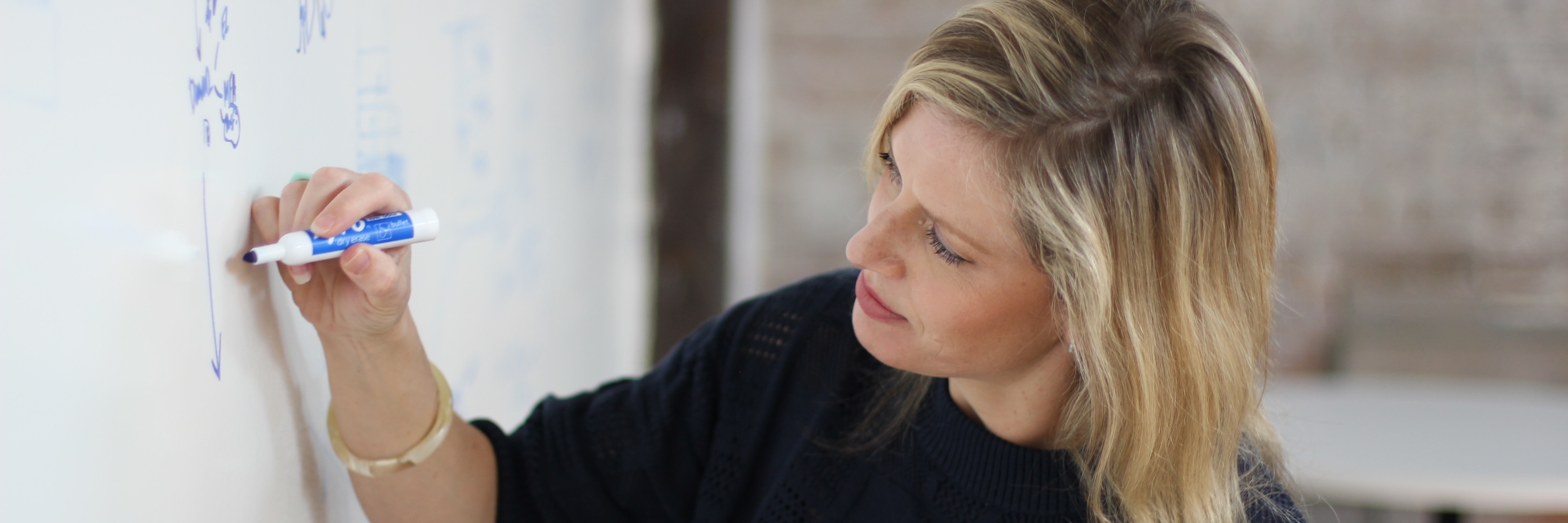
Dr Leanne Sobel on her time at Snowmelt and what comes next

We're taking a moment to reflect on almost two years of Snowmelt working with Dr Leanne Sobel. We've been very fortunate to be graced by her presence over this period and have learned an incredible amount from her as part of our team. Leanne is now leaving her role as Director, Strategic Design at Snowmelt to give her the space to pursue her PhD topics, but she won't be going too far. We are welcoming her as an expert collaborator of Snowmelt, and we're delighted to continue the conversation, with many projects and ideas we'd still like to pursue together. I sat down with Leanne to ask a few questions as she makes the transition.
Leanne, we've covered your background in another article, but can we just recap where you were coming from and how you came to join us?
Yes, I have a bit of a diverse background, but the long story short is that I have a background in design, in visual communication design, and have always been very interested in the intersect between design and business. I really followed the rise of design thinking in terms of the kinds of roles I was going into and the kinds of things I was learning. I did a Master of Management many years ago, back in 2011–12, and that set my interest further into developing a position and a view of where design could go, from a practice perspective, into organisational change and strategy.
So fast forward. I had some time in corporate consulting, and I worked at the Design Innovation Research Centre at UTS for a period. Through that experience I had the opportunity to take on a PhD project, and I was lucky enough to dive right into my passion topic: the role of design in strategy. Through that period, Tim, you and I connected again through my research. And as I was finishing up, it so happened that you had a role available. We had lots of chats, and it was perfect timing for me to come in and see what we could do together, combining our research interests and the fabulous work of Snowmelt. And so there has been for the last almost two years.
It's been quite a journey. You joined us as you were finishing your PhD. Can you tell us what that experience was like for you?
For me, I've always had a career where I've been in academia in some form, so I've always been very interested and curious to engage with what's going on in the literature. Working at the Design Innovation Research Centre was perfect because there was that lovely mix of practice, so we were working with clients, experimenting, doing that work, and then writing and researching on it. And three years, nine months (not that I was counting) of PhD time put me deep into the literature, thinking very deeply about the so what, the potential and the opportunities, and also about what was going on in practice, because my PhD interviewed practitioners, both strategists and strategic designers.
Coming out of that very deep academic thinking, I was very keen to connect with practice again and start to experiment with what I knew as part of my own practice, but looking at how to expand it. So coming and joining you and the team really met me at that moment of: ‘I've got all this thought and knowledge, and I'm very keen to put it into practice’. And then I was met with this fantastic world of systemic design, which my study hadn't really intersected with, apart from the overlay and connections with strategic design, looking very holistically at organisational problems and how I have worked as a design practitioner in the past.
That experience was exciting, I have to say. I reflect fondly on seeing some of your work in those early days when we were talking, and just being blown away at how you had developed a methodology, a practice and approach to taking complex problems and transforming how they are conceptualised, and how you work through them with clients into that systems space. So I was very excited. And I have to say it was a bit mad, wasn't it? Because I was finishing my PhD and starting a new job at the same time. But also very, very energising.
I don't think you'd have it any other way, Leanne. Your research has made incredible contributions to the practice of strategy with a design lens, and some of the frameworks and perspectives you developed through that work we were able to draw on a lot through our practice, to really hone in on what we were doing and the distinctions that mattered.
So reflecting that back: what have you learned about the practice of strategic and systemic design from your time at Snowmelt? Acknowledging you are already building on a career of studying this, so I'm curious what stood out to you.
For me, and particularly working together on some of the big multi-stakeholder challenges I stepped into at the beginning of our time together, looking at international development work, the really interesting part was that we're talking about big systems change, but a lot of the time it really does just come down to people and how people work together. Design brings a really useful capability and framework, and even just a sensibility, which is what came out in my study, in how we engage with people around the complex problems they're facing.
Even though there might be these big impact-driven ambitions and goals that organisations are trying to work towards, at the end of the day it still comes down to how people are meeting their minds together on those big visions, and how they're aligning their work with more traditional organisational practices. That's where my eyes were very wide open when we were in the room working with our partners in the Netherlands, which was fantastic. Just looking at the kinds of conversations we had with them were, yes, about teamwork, but also about how the change that they were trying to realise was connecting with the bigger organisations. There were still big questions for strategy, for management, for challenging some of those traditional conventions, or asking ourselves in the first instance what we understood about their world, and then asking the people we were working with to translate that back to us to say what is it that you need?
So looking at the systems piece does actually marry up very beautifully with ideas of strategy and identity and organisational change, as we have come to write about in our time together. What it has done for my practice and my continued curiosity is to start to look at systems more generally, and at the linkages between design and the human side of design, working with people to try and facilitate change, but with strategy in mind. So, what does it mean for an organisation, what does it mean for the specific choices they're making, and what does it mean for day-to-day practice? Some of the really practical, pragmatic stuff that often gets left out of strategy decks.
I'm very proud of the paper we authored last year for the Relating Systems Thinking and Design (RSD) conference. We were able to codify a lot of those themes you've just described. I think that was a really great moment of bringing together all of your expertise and background with observations of what we're doing in practice, and it has certainly helped us in all of our subsequent engagements. You can read it here.
So from your experience, going further back beyond Snowmelt, but also what you've learned here, what does it really take to do meaningful systems change? What does it require, and what may get in the way?
I think the starting point is really where we left off with that last question: it does come down to people. And what makes systems change hard is that you have multiple people involved, multiple actors, and they could be placed somewhere you don't even know where they are. So how do you find out who these people are, and what potential barriers or influence is that they might have? There's the people-connecting side of change: how you bring people into the conversation, how you meaningfully engage in dialogue and bring people into the work, shaping the future directions together and building momentum that way. You and I have talked a lot about this, and you taught me this too, that you look not only for what you want to change, but for what's working well to then amplify within the system. So it's looking for that, and for who's doing that work.
Not dissimilar to design thinking and all the literature around design in organisations, the biggest challenge is people's capacity to see the potential of working in a different way. It's also about people's potential to work collaboratively at a systems level. And so how can you help people involved in programs of change see the potential of making decisions within their organisational context that have a bigger remit, beyond traditional reporting cycles, or whatever it is people are working towards? That's what it takes. And therefore, it often means challenging some of the more comfortable approaches, or normalised processes and practices within the organisation itself.
So speaking to your question of what are the kinds of the barriers or the things that make it challenging: I think it's about the traditional constructs of organisations and management, and what people think they need to do to carry themselves forward, versus opening up to a bit of curiosity and trying something different. There's enough literature out there now saying organisations are operating under increased complexity. You only need to look at how markets are fluctuating day to day to know that in order to contribute well to an organisation, you have to have some ability to adapt, which means performing differently in your work. And that's only amplified when we're thinking about systems-level change.
And to your point, Tim, systems change can happen within an organisation. This is another thing you've reminded me of on a number of occasions. Systems change can be big, it can be about the multi-stakeholder challenges, the national agendas, engaging broad numbers of people, particularly in the international development space, for example. But it can also be about how you see yourself in your organisation, or even your team. So those barriers exist wherever you're at. It's more about questions of scale, and having the right kind of sponsors, people who understand that it takes a different type of management style to realise the impact, one that will more likely require teams to think outside of their own particular domains. And that can be within an organisation, but it might also be working broadly within a system and sector, across organisations.
Your point about systems also showing up in small ways is really helpful for people who want to get started on the journey. It's not necessarily about really big, hard things all the time. I think your point around what are some of the little interventions and relational pieces that you noticed in some of our first projects working together is really important. We're talking about the intersection of strategic, systems and design practice here, which can often sound very big and amorphous. What are some ideas for how people can get started and move into that space?
It comes down to looking at what you're doing and asking yourself: what can I do differently here? What is required? A lot of the time, even if I think about teaching in the Executive MBA at UTS and other executive training models, it often comes down to how you're doing your work with other people. The foundations of good design are really about sensing into what's going on in your environment: what's happening within your team, what's happening outside of your team. If you have a particular challenge or something to resolve, what are the dimensions of that challenge? How does it become a challenge, and who does it involve?
It's asking those really basic questions and taking a moment to not just jump into solution mode, giving yourself a chance to scan around your context, to see how you are with your team and the relationship between what you're doing and other people within the organisation, and to start to have conversations just to see the issue from multiple perspectives. For me, that's the basic-level thing to be doing, and it's the one thing we so often don't make time for. We think: we've got this particular issue, let's make a decision at this team meeting right now about what we're going to do, without pausing for, say, half a day and saying, maybe I should get on the phone and talk to so-and-so in this department. It might be finance, or HR, or an adjoining team, just to understand how the problem is showing up for them, or what their role is in it, so you can get a better sense of what's going on. It's doing that systems work relationally. Yes, you can map it and write it down, but it's about giving yourself a chance to diagnose your situation, and then see what roles those people you've now taken the time to talk to might have in supporting you to try and facilitate some sort of change. That's the base level, the next best thing anyone can do, I think.
If I boil it back to my research and think about where does design come into it: fortunately, we all have different educational backgrounds, and we all have something of expertise to bring into our work, and it's important to recognise that from the beginning. And to know that the reason for design and design practitioners come into work, particularly around complexity, change and innovation, is that designers tend to bring a specific type of approach and practice that is learned in studio-based learning. It's come from design critique. It's come from experimentation. It's come from design research as a methodology. So there is something particularly helpful coming from design practice and practitioners into the workplace. Even though design thinking is very much a methodology that you can engage with, it's come from design practice, and design practitioners have very much this sensibility around exploring the problem already. That would be the very first instinct a designer would have coming into any problem space is to look at it a bit more forensically. I think Kees Dorst talks about the archaeology of a problem in his book Frame Innovation. It's looking at the archaeology of the problem and trying to really get it down.
My other point is: if you have a designer that’s somewhere within your team or somewhere in your orbit or remit in the organisation you're working within, bring them in for a bit of work with you, just to see what that perspective brings into understanding a particular problem space or challenge, just to see how that perspective might give you something different or a nuance into your team to try and help set it forward. I think the other part of that is that designers tend to see problems more holistically, and hence the connection to systems thinking at that level of strategic design. It's a bit of a long explainer, but I would just start there.
There's a lot listeners can take away from that. One thread throughout a lot of what you've shared is reflecting in and on practice, and the ability to do that is not common practice in organisations. Having robust processes, spaces and questions to explore in a holistic way is something you've brought an enormous amount to our team over these almost two years, from your PhD studies, and helping us create additional moments, internally or with clients, to really focus on reflecting on practice, or in practice. It's so core to systemic and strategic design: being able to make sense of the spaces you're working and operating in, and understand what to do next, what your options are, and how to navigate.
Looking forward from here, I know you've spent your career deeply interested in these practices, codifying them and understanding the distinctions that make a difference in them. What do you still see as the potential for strategic and systemic design in the future?
Look it's interesting, because the flavour of design and design thinking is not talked about as much as it was, say, ten years ago. I think that's totally part of the cycle, and I don't want to see design become a bit of a flavour of the month and move away. I think we're at risk of that at the moment. And there are good reasons why it's not a big thing in the press right now, with AI and all the complexities going on in our world. But I would say the challenges persist, and the reasons for employing a design practice into organisational challenges remain.
I read an article in the HBR a couple of weeks ago, called The Octopus Organization. Everything in it, for me, pointed to good design and good design practice, exactly this idea of experimentation and reflection and sensemaking, all those sorts of things and that is all to deal with the complexities in the world today. But it did not mention design once. I think that's evidence that the press has moved on, and the way people are talking about it has moved on, but the point is that design practice remains relevant, and I think where designers are now working has changed. The so what of design thinking becoming so big, and organisations developing design capabilities as a competitive advantage for innovation, has left a mark on how organisations see design and how they've embedded it within organisations. So I think part of the lack of fanfare around design is that it's just commonplace now. It's become a distributed capability that people have.
So the job to be done is to continue to understand how designers are working in practice, how the practices are evolving, and how they're adapting as organisations are having to adapt. And what is the ‘so what’ of design in the face of AI, thinking about the lovely conversations we've been having more recently with Tony Fry, what is responsible design practice, what is responsible organisational practice, in light of sustainability, sustainment, and these quite frankly scary futures that we're facing? How are we preparing ourselves for that, and what does that look like for design practice, and ethical, responsible practice that supports a flourishing society? Not just designing for organisations to perform economically, but designing to make sure we have a flourishing, healthy society and environment going forward. And they are big questions, and there's lots of work being done in that space. But particularly for me, progressing the work on the role of design in strategy is to say there's a lot there for us to understand when it comes to looking at the systems level change, which we all need to attend to when we see these big shifts in how we're living and being in the world.
There's a lot of value design practice can bring to our present moment, as you've just described. There’s a lot in there in design not just as innovation and the new thing, but as a way to de-risk and understand the pathways we're taking and their implications of those over time. So, final question: what are you looking forward to doing next?
Well I've probably got to a point now where I can look again at my PhD thesis. There was definitely a moment where I just needed to park it, but as you know, there are papers that I wish to write and publish, and so I've got work there at the ready. I want to share it with the world. That's been a really persistent calling for me, and as a team we've talked about that a lot. So that's my first priority. And then, going back into the network, into community, into industry and going back to design practitioners and just getting a sense of what's going on and how I can contribute.
I'm very passionate about continuing to share the stories, and the "so what" of design now. Now I know that design isn't everything, so it's about contextualising it in the broader remit of skills, so in that transdisciplinary frame: the way design can help bring diverse skill sets, knowledge, industry and sectors together to work through and wade through complex challenges. That's what I'm excited to do, and also just to reflect on where the study and the work I have done can contribute to that, and then what questions might fall out of that to continue to expand on the work.
While I'm very interested in the research, writing and knowledge development, I'm also very interested in making sure that what I'm doing is embedded in practice. So whatever work I do going forward, there will be an element of the work: working with clients, partners, and people like Snowmelt, in my continued capacity to experiment and actually apply what we now know works well. I think we have gotten to a point that even beyond the paper we wrote, those frameworks, those patterns, those methodologies exist. So let's go do that a little bit more, and keep sharing it with the world. And there are lots of stories where people like Snowmelt and other companies are doing great work. So how can we get that out there a little bit more?
I'm hoping that the research and the work I'm doing can be part of the community of practice, and that it helps us as designers, as an industry, but also more generally what we're doing here in Australia around design. Maybe there's something we can reinvigorate to get some of that practice going and being discussed again, particularly at a government level. I'd love to see design start to enter the dialogue again around innovation, change, science, and shaping our futures well.
Hear, hear! We agree with all of that, and we're really excited to hear what Leanne gets up to next. As an expert collaborator of Snowmelt, we look forward to future engagements. Stay tuned for collaborations coming in the next few months between us as well.
Learn more
- Read Tim and Leanne's paper for the Relating Systems Thinking and Design (RSD) symposium: A complexity paradigm: four dimensions of management where systemic design practices support work in complexity
- Read "Become an Octopus Organization" in Harvard Business Review (paywalled)
- Explore Tony Fry's work at The Studio at the Edge of the World
- Read the UTS case study on Leanne's PhD: Design's transformational role in strategy
- Follow Leanne's research on ResearchGate
- Connect with Leanne on LinkedIn

Related articles


